

The 1.3-m mirror in its box prior to the coating process. Notice how hazy the surface appears due to the accumulation of dust and debris on the mirror. The dark streaks and patches are places where the aluminum coating has deteriorated due to exposure to water and other tarnishing agents. Note the reflection of a ladder and other structures across the room that are seen in the mirror.
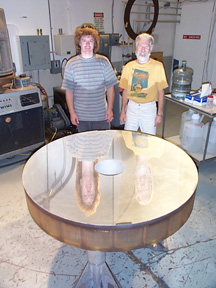
Richard Gelderman (left; WKU) and Steve Howell (right; PSI) stand before the 1.3-m mirror prior to stripping. As noted in the above picture, the mirror is very hazy due to the accumulation of approximately 6 years of dust and debris.
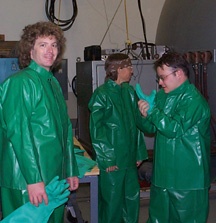
(From Left to Right) Richard Gelderman (WKU), Carol Neese and Gil Esquerdo (PSI) get dressed in green, acid proof over-suits. The mirror is stripped using first a hydrochloric acid and copper sulfate solution, and then "scrubbed" with calcium carbonate and potassium hydroxide. These chemicals, while relatively weak, are not people friendly and require the use of these acid impervious suits as to prevent burns on the skin.
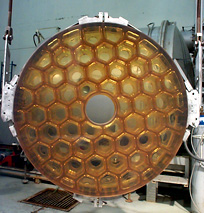
The 1.3-m mirror after stripping of the old aluminum surface and a thorough cleaning. The hexagonal cells that were machined out of the back of the mirror blank to make it lighter can be seen. Since telescope mirrors use their fronts to reflect, rather than the back like your bathroom mirror, lightweighting the blank like this does not affect the performance of the mirror. The amber color is due to the fact that the mirror is not "real" glass. It is a material called Cer-vit which has much better thermal properties than regular glass.
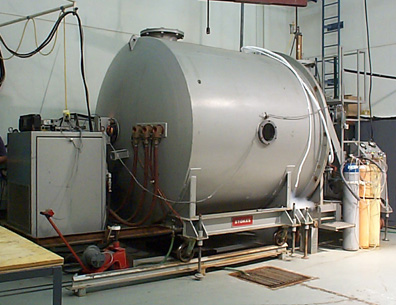
The Kitt Peak Solar Aluminizing tank is seen here. The Tank stands about 10 feet (3m) tall and 15 feet (5m) long. Inside the tank, at the close end, are a large number of tungsten coils, much like those in a lightbulb filament. The coils are interwoven with aluminum, and when current is passed through the tungsten, the aluminum is vaporized into individual atoms and flies at 500 to 600 miles per hour to the other end of the tank where the mirror is placed. At the time that this picture was taken, the mirror was moments from being coated. The pressure in the tank at the time was 3x10⁻⁶ torr, or about 1 billion times less pressure than atmospheric.
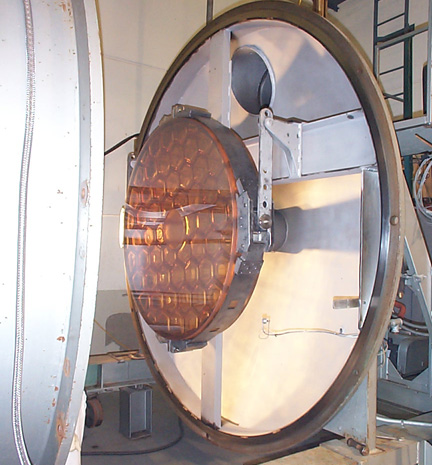
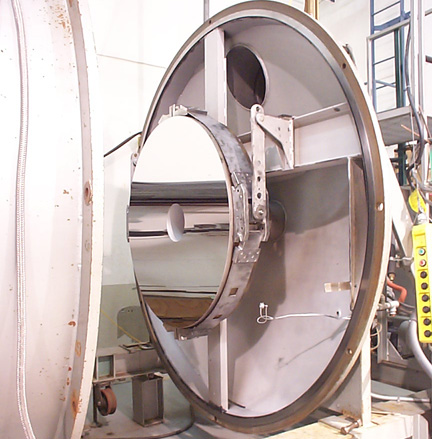
This pair of photos taken from the same spot in the building but almost 24 hours apart show the 1.3-m mirror in the aluminizing tank. In the first, the mirror can be seen stripped and before coating. This picture was taken just moments before closing the tank and beginning to pull the vacuum necessary to coat the mirror. In the second, the freshly coated mirror is seen just after opening the tank to reveal its new and improved reflective surface. Notice that the hazy appearance seen prior to coating is now gone.
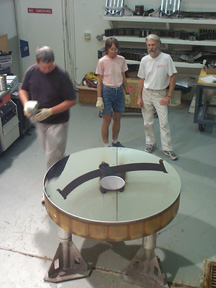
Gary Poczulp, NOAO (left) is seen making reflectance measurements of the freshly coated 1.3-m mirror while Carol Neese (center) and Steve Howell (both PSI) look on. Again, note that the hazy appearance seen prior to coating is now gone, and the surface has a beautiful, uniform reflectance. The large, dark, curved structure seen in the mirror is a piece of hardware located on a wall across the room. It is seen in reflection. Since the mirror is curved (to focus starlight) the hardware appears curved in reflection.
All those involved with the recoating of the RCT primary mirror would like to thank Gary Poczulp of NOAO for all of his assistance in the process of stripping and coating the mirror. Additionally, we would like to thank him for his patience in answering all of our questions during our two and a half days together.