Items are listed in Reverse Chronological Order.
The telescope and camera have been operated successfully for the past several months using scripts. About 1Gbyte of data is collected on a typical clear night.
Progress continues on the RCT control software, allowing more complex sequences of observations. More test data is taken and analyzed.
First light observations have been made with the CCD Camera and the post-refurbishment RCT. Data taken at the RCT were presented at the American Astronomical Society's 2003 summer meeting in Nashville.
The CCD camera has arrived! The San Diego State University CCD lab has completed work on and delivered to PSI the CCD camera for the RCT. The camera will now be taken to EOST so that it may be integrated into the telescope control software that is being written there. Once the software is complete, work can begin on bringing the telescope back to full functionality. We expect first light in the next few months.
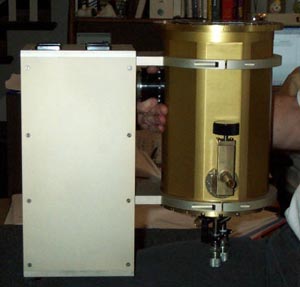
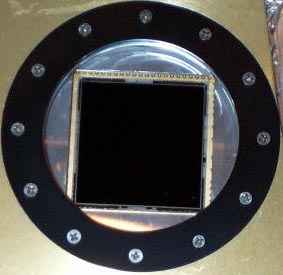
Below are two pictures of the CCD dewar assembly (left) and the CCD detector in the dewar (right). For refernce, the CCD detector itself is approximately 2 inches across.
In the couple of months since the last update, a lot of work on the telescope has been completed, but very little of it has been visible. EOST has been busy setting up the new motors, encoders and software interfaces to the RCT. Some of this has already been installed on the mountain. On the 12th of October, when the photos here were taken, conduit to contain the cabling for the weather station was being run. It is small progress like this that is necessary, but is far from glamorous.
The greatest milestone in the past couple of months has been the re-installation of the optics into the telescope on August 14th. At a theoretical level, we could open the dome and mirror covers and actually collect light. However, without object acquisition or tracking capabilities, at best we could only watch the sky directly overhead drift by.
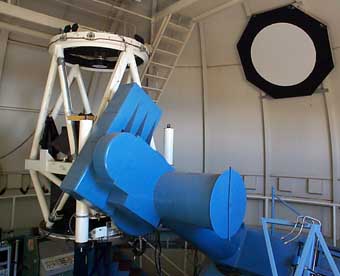
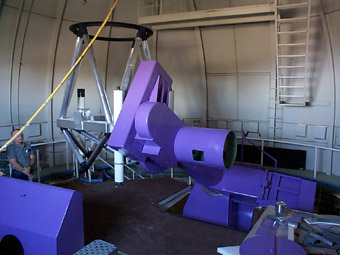
Here is an image of the telescope taken from the catwalk that spans across the top of the dome showing the telescope as it appears now. Short of a few covers and a little clean up, this is essentially how the telescope will appear when it is completed in the first months of 2002. Engineering and other tests of the telescope should start in December.
The CCD camera is scheduled to arrive at PSI from the San Diego State University CCD Lab before the end of October. At the time, PSI scientists will conduct tests to evaluate the performance of the camera prior to sending it to EOST for integration with the telescope control and automation software they are writing.
From June 18 to 20, Richard Gelderman (WKU) as well as Steve Howell, Carol Neese and Gil Esquerdo (PSI) travelled to Kitt Peak to assist with the recoating of the 1.3-m mirror. Unloading of the mirror and chemically stripping the mirror occurred on the 18th. On the 19th, the last of the cleaning process was conducted and the mirror loaded in the vacuum tank. By 3:00 that afternoon, the buttons were pushed and in approximately 5 minutes, an aluminum coating 1.024 microns thick was deposited on the mirror. The vacuum tank was allowed to re-equalize with the outside atmosphere overnight and on the morning of the 20th, the mirror was removed from the tank and placed back into its shipping crate.
In the days following, the mirror was returned to the RCT dome and is scheduled to be reinstalled in its cell and placed back into the telescope by mid-July.
Pictures from the recoating can be accessed here.
The telescope has been painted! It is now a lovely shade of purple known as "celestial lilac". This marks the beginning of the major push to finish the main portions of the refurbishment. In the coming weeks, EOST will be installing the new motors, cabling, encoders and other primary components that were removed and brought to their workshop in Tucson for refurbishment.
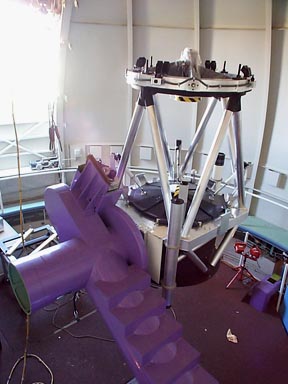
Below is an image of the beautifully purple mounting for the telescope. It also shows the overall condition of the telescope as it stands as of early May. The trusswork (as mentioned before) has been aluminum wrapped, and this new shiny surface can easily be seen. Additionally, the mirror cell and top ring are missing, as are all of the drive components, which cannot be seen in this picture. There is plenty more work to happen in the coming weeks.
There has been a significant amount of work condicted on the RCT telescope in past months, but the work conducted was a number of small engineering and refurbishment items, all too numerous to mention here. All told, progress in on schedule, and we are still anticipating the "second" first light for the RCT this fall.
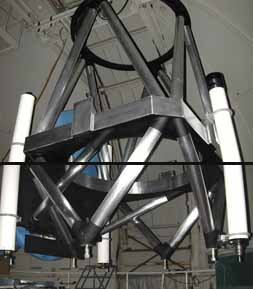
The most noticable step has been the wrapping of the telescope truss structure in a highly reflective tape. This tape has excellent thermal properties, which prevent the telescope from heating up greatly during the day, yet also allow rapid cool down of the structure in the evening when we open for observing. As a result, the scope is now a beautiful shiny silver-grey color.
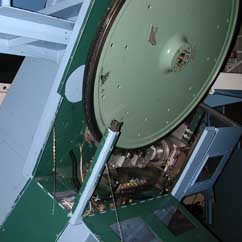
The two images below were taken by Don Davis on Kitt Peak in the early part of the month. The first shows the wrapped telescope structure. Note that the mirror cell and top ring are both missing. These are in Tucson at EOST where they were refurbished. A photo of the finished top ring can be seen in the November 2000 progress section. This is a combination of two photos roughly aligned to show the whole structure. The second photo shows the interior of the drive unit of the telescope. It is now open and most of the gears, enoders and wiring has been removed and transported to Tucson for refurbishment, replacement and engineering. What can be seen in the image is the large drive gear that allows the telescope to track across the sky.
Plans are in place to paint the structure of the telescope in the coming month or two. The consortium has tentatively decided on purple, though the exact shade has yet to be decided.
The electronics cabinets for the telescope have undergone their design, draft and critical review. These cabinets will hold the computers and necessary electronics to make the telescope work. Hundreds of drawings of the necessary circuits and connectors were reviewed for compatibility and completeness. In the coming months, these cabinets with their necessary components will be constructed.
In this time, a design study for a focal reducing assembly (which will give the telescope a wider field of view) has been conducted. The result of this study was that the use of a focal reducer with the RCT is impractical at this time. This will require slight modifications to how consortium members gather data in their targets of interest, but will not have an adverse impact on the use of the telescope.
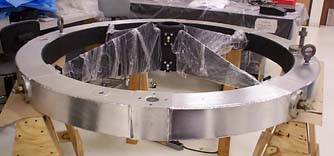
The telescope top ring (the upper part that supports the secondary mirror and focus assembly) has been finished. It is wrapped up at EOST and is ready to be integrated back into the telescope when other parts are completed. The photo below shows the finished top ring at EOST.
Additionally, the focus mechanism has been rebuilt. The individual components are ready for assembly and testing.
In the past month and a half, the guider box (the attachment near the focus of the telescope that holds the science and guiding cameras) as well as the filter wheel assembly has been designed, drafted and critically reviewed. The guider box will undergo the final design review and construction will begin in the coming months.
The telescope has been dismantled and moved to the labs at EOS Technologies (ESOT) in Tucson where the restoration will take place.
The RCT consortium has chosen EOS Technologies (EOST) to refurbish the telescope for our purposes. In a review of a number of bids, it was determined that EOST was the company best able to bring the RCT to the operational level the consortium desires.
Staff from Western Kentucky and PSI visit the RCT on Kitt Peak to evaluate its condition and to allow prospective bidders to see the condition of the telescope for themselves in order to prepare their bids. The scope was made operational for those two nights by the hard work of the Kitt Peak support staff. We thank them for their effort in making the RCT operational again after 5 years in mothballs. The photo below shows the RCT during the test observations.